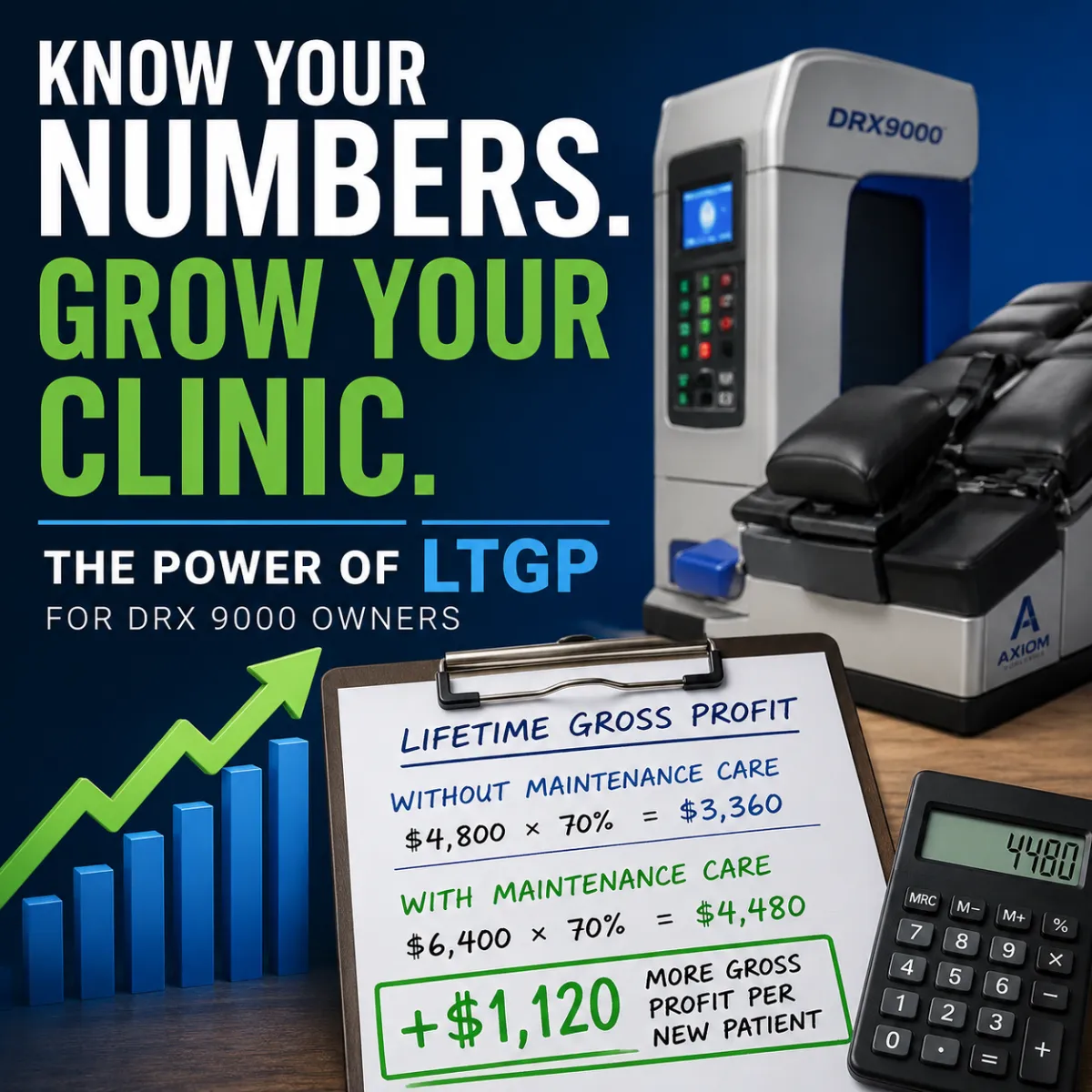
Why Every DRX 9000 Clinic Needs to Know Its Lifetime Gross Profit
Why Every DRX 9000 Clinic Needs to Know Its Lifetime Gross Profit (LTGP)
If you're marketing your DRX 9000 clinic without knowing your numbers, you're gambling.
Every month, clinics invest in Meta ads, Google Ads, SEO, mailers, and referrals, hoping those dollars turn into patients. But many owners can't answer one critical question:
"How much gross profit is a new patient actually worth to my clinic?"
Without that answer, it's impossible to know whether your marketing is truly profitable.
That's where Lifetime Gross Profit (LTGP) comes in.
What Is Lifetime Gross Profit?
Lifetime Gross Profit (LTGP) is an estimate of the total gross profit a patient generates over their relationship with your clinic.
Patients are far more than numbers on a spreadsheet, but if you want your marketing to be profitable and scalable, you need to understand the economics of acquiring them. Even a rough LTGP estimate is far better than guessing.
Step 1: Calculate Lifetime Revenue
Let's use a simple example.
Suppose your average DRX treatment plan includes:
24 visits
$200 per visit
Your lifetime treatment revenue is:
24 × $200 = $4,800
Step 2: Calculate Gross Profit
Revenue isn't profit.
For most DRX clinics, the cost of delivering treatment is relatively low because the DRX 9000 is already in the office. The primary costs are staff time, electricity, and other small treatment expenses.
A 70% gross profit margin is often a conservative estimate.
$4,800 × 70% = $3,360
Your estimated Lifetime Gross Profit (LTGP) is:
$3,360
Why Gross Profit Instead of Net Profit?
Net profit includes rent, marketing, insurance, taxes, and overhead, which vary widely between clinics.
Gross profit answers the question marketing actually cares about:
How much profit does each new patient create before overhead?
Knowing that number tells you how much you can afford to spend acquiring another patient.
The Impact of Maintenance Care
Now let's include maintenance care.
Assume:
1/3 of patients continue maintenance care.
Maintenance costs $200 per month.
The average maintenance patient stays 24 months.
Maintenance revenue is:
$200 × 24 = $4,800
Since only one-third of patients continue, the average maintenance value across all new patients is:
1/3 × $4,800 = $1,600
Add that to the original treatment revenue:
Initial treatment: $4,800
Average maintenance value: $1,600
Average lifetime revenue becomes:
$6,400
Applying the same 70% gross profit margin:
$6,400 × 70% = $4,480
Your new estimated LTGP is:
$4,480
Why This Matters
Without maintenance care:
LTGP = $3,360
With maintenance care:
LTGP = $4,480
That's an increase of $1,120 in gross profit per new patient—without spending another dollar on advertising.
Improving patient retention increases the value of every future patient your marketing generates.
Marketing Stops Feeling Like Gambling
Once you know your LTGP, your marketing decisions become much smarter.
Instead of asking:
How many leads did we get?
What was our cost per click?
You start asking:
How much gross profit does each new patient create?
How much can we afford to spend to acquire one?
Which marketing channels produce the highest-value patients?
Should we focus on lowering acquisition costs or increasing patient retention?
Those are the questions that build profitable clinics.
When you know what a patient is worth, you stop making marketing decisions based on hope. You know how much you can invest to acquire a patient, evaluate campaigns with confidence, and scale your clinic using data instead of guesswork.