Direct vs. Indirect Attribution
Direct vs. Indirect Attribution: Are Your Ads More Valuable Than You Think?
When a new patient walks into your clinic, how do you know what marketing actually caused them to come in?
Was it a Facebook ad? A Google search? A referral from a friend? Or was it a combination of several things?
This is where marketing attribution becomes important.
Attribution is simply the process of determining which marketing efforts contributed to a new patient choosing your clinic. For DRX9000 owners, understanding attribution can give you a much clearer picture of whether your marketing is actually working.
There are two important types to understand: direct attribution and indirect attribution.
What Is Direct Attribution?
Direct attribution is the easiest to measure.
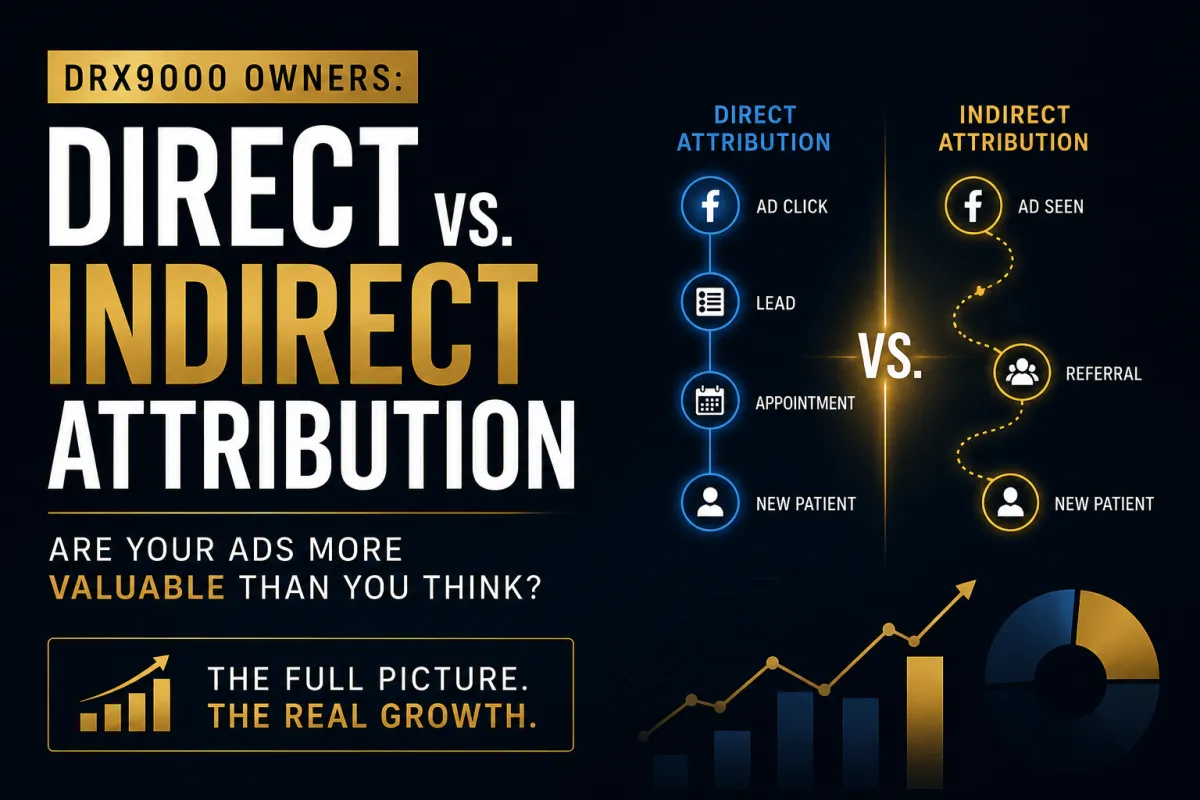
Imagine someone sees your Facebook ad about spinal decompression, clicks the ad, submits their information, schedules a consultation, shows up, and eventually starts care.
That patient's journey looks something like:
Facebook Ad → Lead → Appointment → Show-Up → New Patient
In this case, you can directly attribute that patient to Facebook.
This is incredibly useful because it allows you to calculate metrics such as:
Cost per lead
Cost per appointment
Cost per show-up
Cost per new patient
Return on ad spend
If you spend $3,000 on Facebook and can directly trace $15,000 in new patient revenue back to those ads, you have a very clear indication that the campaign is producing a return.
But direct attribution doesn't always tell the entire story.
What Is Indirect Attribution?
Not every patient schedules an appointment the first time they encounter your clinic.
Consider a different patient journey.
Someone sees one of your Facebook ads about spinal decompression. They watch the video but don't click or schedule.
A few weeks later, they're talking to a friend about their back pain.
Their friend says:
"You should check out that clinic. I've heard good things about them."
Suddenly, the clinic sounds familiar.
They remember seeing the doctor. They recognize the name. They've already heard the message about spinal decompression.
So they schedule an appointment.
If you only looked at direct attribution, you would probably record that patient as a referral.
And technically, that's correct.
But did the Facebook ad have zero impact?
Probably not.
The referral may have been what finally caused the patient to take action, but the advertising helped create awareness, familiarity, and trust before that conversation ever happened.
That's indirect attribution.
Most Patients Don't Live in a Straight-Line Funnel
This is where attribution becomes complicated.
Patients don't always follow a perfectly measurable path from advertisement to appointment.
Their journey might actually look more like:
Facebook Ad → Google Search → Website Visit → Facebook Ad Again → Friend's Recommendation → Appointment
Which source deserves credit?
The referral may have generated the final action, but Facebook introduced the clinic. Google helped the patient research it. The website built credibility. Another ad reinforced the message. And the referral finally pushed them to schedule.
Every one of those touchpoints potentially contributed to creating the patient.
Why Clinic Owners Should Care About Indirect Attribution
Many clinic owners judge their marketing almost entirely through direct attribution.
They ask:
"How many new patients came directly from Facebook?"
That's an important question. You absolutely should know the answer.
But it shouldn't be the only question.
Effective marketing does more than generate leads.
Marketing builds awareness.
Marketing creates familiarity.
Marketing builds trust.
And those effects can influence patients who eventually enter your clinic through completely different channels.
Someone may see five of your videos over three months before finally searching your clinic on Google.
Another person might repeatedly see your ads and then recognize your name when a friend recommends you.
Another may never become a patient themselves but mention your clinic to a family member experiencing back pain.
Those effects are extremely difficult to capture through direct attribution alone.
Your Marketing May Be Worth More Than Your Dashboard Shows
This has an important implication when evaluating the ROI of your advertising.
Imagine your advertising is roughly breaking even based purely on directly attributable patients.
At first glance, you might conclude:
"We're spending $5,000 and directly generating about $5,000 in profit. What's the point?"
But that calculation ignores the potential indirect effects.
Your advertising may simultaneously be generating:
More branded Google searches. More referrals. More website traffic. Greater local awareness. Increased familiarity with your doctor. Future patients who haven't scheduled yet.
That doesn't mean you should ignore direct ROI or continue running campaigns that clearly aren't producing results.
It means direct attribution should be treated as one piece of the measurement puzzle rather than the entire picture.
The Better Question to Ask About Your Marketing
Instead of only asking:
"How many patients came directly from this ad?"
Start asking:
"How much is this marketing helping more people in our community know, trust, and ultimately choose our clinic?"
Track direct attribution as accurately as possible. Know your cost per lead, booking rate, show-up rate, cost per new patient, and return on ad spend.
But remember that some of the value created by marketing won't immediately appear inside your advertising dashboard.
Especially in healthcare, patients may need multiple interactions with your clinic before they're comfortable scheduling an appointment.
The ad that doesn't generate an appointment today may still be one of the reasons that patient chooses your clinic three months from now.
That's the difference between measuring leads and measuring the true impact of your marketing.
Watch the full video here